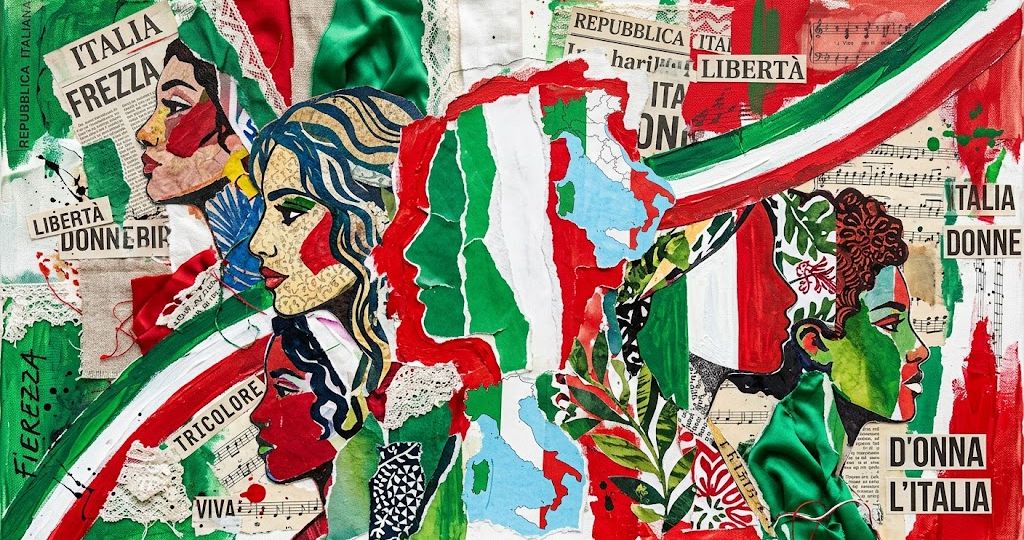
Italy isn’t just about ancient ruins and Renaissance masterpieces – it’s a country shaped by extraordinary women whose stories remain largely untold. From Roman empresses who ruled empires to Renaissance duchesses who championed the arts, from medieval saints who challenged authority to modern architects who redefined skylines, these women left an indelible mark on Italian culture.
This journey offers a fresh perspective on Italy’s greatest treasures: visit the Uffizi in Florence not just for its art, but for Artemisia Gentileschi’s revolutionary paintings; explore Venice‘s palaces through the eyes of powerful dogaresses who shaped the Serenissima behind the scenes; in Turin, follow the footsteps of Christine of France and Maria Giovanna Battista of Savoy-Nemours, the regent duchesses who left their mark on the city’s royal palaces; and in Milan, trace a very different lineage of influential women, from Renaissance duchess Beatrice d’Este to designer Marieda Di Stefano and poet Alda Merini.
In Siena and Assisi, walk in the footsteps of Catherine of Siena and Clare of Assisi, two medieval women whose spiritual authority rivaled that of popes and kings; and in Rome, trace a story that spans millennia, from the sacred Vestal Virgins of the Forum to trailblazing architect Zaha Hadid.
It’s the perfect excuse to experience Italy’s stunning diversity – world-class museums, breathtaking landscapes, incredible cuisine – while uncovering the hidden half of history that deserves to be celebrated.
Journey through women’s Italy:
day 1 – 3
Upon arrival in Turin, you will stay in a hotel of excellence and from here your journey to discover the women who have played a part in Italian history will begin.
Palazzo Madama
With a private guided tour, you will visit Palazzo Madama where, in the permanent exhibition rooms, the female presence is recounted through different roles: patrons, craftswomen, subjects, or creators of everyday objects and works of art. Palazzo Madama was also chosen by Christina of France as her personal residence and seat of her court, thus taking on the name “Madama Reale” (Royal Madam). Decades later, Maria Giovanna Battista entrusted architect Filippo Juvarra with the task of renovating it, commissioning the extraordinary Baroque façade and the majestic grand staircase. These two extraordinary women had a profound impact on the society and artistic culture of the Savoy state, exercising power with intelligence and determination, in an entirely feminine way, to assert their role and defend the autonomy of their state.
Royal Palace of Turin
You will also visit the Royal Palace of Turin, where women played a decisive role. Queens, duchesses, and princesses of the House of Savoy transformed the court into a center of power and culture. Through art, diplomacy, and patronage, they profoundly shaped the history and identity of the Savoy monarchy and the city itself.
Mole Antonelliana
It takes its name from architect Alessandro Antonelli, who began its construction in 1863. Originally conceived as a synagogue for the Jewish community, it soon became city property and today houses the National Museum of Cinema, one of Turin’s most iconic landmarks. Its galleries trace the history and magic of filmmaking, from early visual experiments to the modern movie industry. From the dome – accessible by foot or panoramic elevator – unfolds one of the city’s most breathtaking views.
The Egyptian Museum
The world’s oldest museum dedicated entirely to ancient Egyptian culture – holds one of the most important collections outside Egypt. Founded in 1824, it preserves statues, mummies, papyri, and everyday artifacts that illuminate 4,000 years of history. Among its treasures stand the statues of Queen Nefertari, Isis, and Taweret, powerful symbols of femininity and divine protection. The museum’s discoveries continue to celebrate the enduring role of women in ancient Egypt’s spiritual and royal life.
Journey through women’s Italy:
Day 3 – 6
From Turin, you can reach downtown Milan in an hour – on a comfortable high-speed train – for the next stop on your journey through “Women’s Italy.”
Milan: Two Days in the Footsteps of Remarkable Women
A walking and transit itinerary through art, history, and the voices that shaped a city
We’ll arrange your stay in Milan at a downtown hotel from which you can easily get around by public transportation or on foot..
You can choose to explore on your own or take advantage of a tour guide for some or all of the destinations listed.
Castello Sforzesco
Start your Milan journey at the city’s most iconic landmark, the 15th-century Castello Sforzesco, which anchors the northern edge of the historic center and is easily reached on foot or by metro.
Beyond the fortress walls and the famous Michelangelo Pietà Rondanini, this is a place to think about Beatrice d’Este — one of the most formidable women of the Italian Renaissance. Married to Ludovico Sforza at fifteen, Beatrice became far more than a duke’s consort. She was a political strategist, a skilled diplomat, and a patron of the arts whose influence shaped the cultural life of the Sforza court. Leonardo da Vinci himself worked under her husband’s patronage during Beatrice’s lifetime, and the cultural flowering of late 15th-century Milan was inseparable from her energy and taste. She died at twenty-one, leaving behind a city she had helped transform.
Santa Maria delle Grazie and the Cenacolo
A 15-minute walk southwest brings you to one of the most visited sites in Italy — and one of the most quietly extraordinary.
Most travelers come for Leonardo’s Last Supper housed in what was once the refectory of a Dominican convent. And yes, the painting itself is worth every minute of the advance booking it requires. But pause before you enter to consider the women who lived and prayed here for generations: the Dominican nuns whose daily rhythms surrounded this painting, who ate their meals across from it, who grew old with it. The Cenacolo was not a gallery; it was their dining room. The fact that a masterpiece was painted on their wall says something about the Sforza court’s relationship to religious community — and about the women who inhabited these spaces that history so often renders invisible.
Casa Museo Boschi Di Stefano
One of Milan’s best-kept secrets: a private apartment turned public museum, frozen in time on the second floor of a rationalist building in the Buenos Aires neighborhood.
The collection — over 300 works spanning Italian art of the 20th century — was assembled over decades by the couple Antonio and Marieda Di Stefano. Marieda was not a silent partner. She was the driving force of the collection: discerning, passionate, and strategically bold, she cultivated relationships with the artists whose work she championed long before the market caught up. Works by Lucio Fontana, Carlo Carrà, and Giorgio Morandi fill the walls exactly as Marieda and Antonio arranged them. Visiting feels less like a museum and more like an act of hospitality — you are a guest in her vision.
Witness, Memory, and a Poet by the Canal: Memoriale della Shoah & the Navigli
Begin the day at Milan’s Central Station — not the grand departure hall above, but the disused underground platforms beneath it, Platform 21, where between 1943 and 1945 deportation trains departed for Auschwitz and other Nazi camps.
The Memoriale della Shoah, opened in 2013, occupies this raw, oppressive space and transforms it into an act of memory. Among the thousands deported from here, the stories of women are especially worth seeking out as you move through the memorial: mothers separated from children, young women who organized resistance within the camps, ordinary lives interrupted and extinguished. The names inscribed on the memorial’s walls are a refusal to let those lives be reduced to statistics. This is not easy visiting — nor should it be.
Step into the Navigli — Milan’s canal district, bohemian and a little rough around the edges, exactly as the poet Alda Merini knew it.
Merini (1931–2009) lived for much of her adult life in this neighborhood, and the Naviglio Grande was her landscape: the barges, the light on the water, the trattorias where she held court, the walls where her verses were eventually painted as a form of civic tribute. She is one of the most celebrated Italian poets of the 20th century, and one of its most tragic figures — hospitalized repeatedly in psychiatric institutions from her late twenties, she lost years of her life to a system that failed her catastrophically. What she produced despite that, and because of it, is extraordinary: verse of raw lyricism, mystical fury, and unflinching self-knowledge.
Walk along the Naviglio Grande and look for the ceramic plaques marking the places connected to her life. Her former home at Ripa di Porta Ticinese 47 is a pilgrimage site for her readers. The neighborhood has changed, but her presence still haunts it.
The Navigli are at their best in the late afternoon. End the day at one of the canal-side bars as the aperitivo hour begins — a very Milanese, and very Alda Merini, way to close.
Journey through women’s Italy:
Day 6 – 9
After Milan, a stop in Venice is a must, where you can admire the city and its monuments and learn about the “Women in the History of the Serenissima”.
Venice is also easily accessible by train in two and a half hours (from the Venice’s station, a private transfer will take you to your hotel in the historic center).
Venice: Two Days Among Women Who Defied the Lagoon
A walking itinerary through palaces, canals, and the lives history almost forgot
Palazzo Ducale
Begin where Venice’s political myth was made. The Palazzo Ducale is one of the most recognizable buildings in the world, and one of the most thoroughly masculine in its official iconography: doges, admirals, councils of men deciding the fate of the Republic.
And yet. Behind every doge stood a Dogaressa, and the most remarkable of them were far from decorative. Alongside the Dogaresse, other extraordinary women shaped Venice’s political story; among them Caterina Cornaro, who surrendered the Kingdom of Cyprus to the Republic in 1489, was received in Venice with a triumphal procession that barely concealed the pressure placed on her to relinquish her crown.
Morosina Morosini Grimani, Dogaressa in the late 16th century, used her position with a political intelligence that contemporaries found remarkable and slightly alarming. Their portraits, where they survive, show women who understood exactly what they were navigating.
As you move through the palace’s gilded halls and the shadowy Piombi prison above, let the Dogaresse complicate the official story. Venice’s Republic was built on the myth of masculine governance — these women lived inside that myth and bent it.
Convento dell’Ospedaletto
From San Marco, walk north through the calli toward Castello to the Ospedaletto, one of Venice’s four historic ospedali, charitable institutions that took in orphaned and abandoned children and gave them, among other things, a formidable musical education.
The Ospedale della Pietà, where Vivaldi worked as violin teacher and composer for much of his career, is the most famous of the four — but the Ospedaletto deserves its own attention. Here, as at the Pietà, it was girls and young women who performed the concerts that made Venice’s ospedali the musical sensation of 18th-century Europe. Travelers came from across the continent to hear them play from behind grilles, their faces half-hidden, their technique astonishing audiences who had rarely heard women perform at this level. They were not permitted to take their music into the wider world – the institutions that trained them also contained them – but within those walls they achieved something extraordinary.
The Ospedaletto’s church contains remarkable frescoed ceilings and the original concert hall. Standing in that space, it is worth thinking about what it meant to be that gifted, that celebrated, and that invisible.
The Ghetto and Sara Copio Sullam
Continue to Cannaregio and enter the Venetian Ghetto, established in 1516 as the first ghetto in the world and the origin of that word in every language.
The Ghetto is a layered, living neighborhood, and its history is not only one of confinement. It was also, paradoxically, a place of intellectual ferment.
Sara Copio Sullam (c. 1592–1641) lived here and became one of the most celebrated literary figures in early 17th-century Venice – Jewish, a woman, and yet at the center of a correspondence network that included poets, philosophers, and clerics from across Italy. She hosted a literary salon in the Ghetto that attracted Christian intellectuals drawn as much by her wit as by the frisson of crossing the bridge after dark.
When a Genoese abbot accused her in print of denying the immortality of the soul — a charge that carried serious consequences — she responded with a published Manifesto defending herself with precision and courage. It is one of the earliest examples of a Jewish woman publishing a polemical text in Italy. The bridge leading into the Ghetto, the campo, the synagogues open for guided tours: all of it is inseparable from her story.
Ca’ Rezzonico
Board the Vaporetto to Ca’ Rezzonico, where the 18th-century palazzo of the same name houses the city’s museum of Venetian baroque civilization. It is an extravagant building — frescoed ceilings, lacquered furniture, Tiepolo canvases — and it tells the story of the Venetian patrician world at its most opulent and most precarious.
Seek out the rooms associated with Caterina Dolfin Tron, one of the most formidable women of 18th-century Venice. The wife of Procurator Andrea Tron (known as “el paron“, the boss, for his political dominance), Caterina ran a salon that was, for a time, the intellectual and social center of the city. She was widely read, politically informed, and unafraid to make her opinions known in a society that did not officially recognize women’s public roles. Her correspondence reveals a sharp, restless intelligence; her salon brought together the reformist currents that were reshaping Venetian culture in the decades before Napoleon ended the Republic.
The museum’s rooms are arranged as a lived environment, this is one of the finest places in Venice to understand what daily aristocratic life actually felt like, and Caterina’s presence gives it a human center.
Libreria Acqua Alta
End your Venice itinerary where the city’s water, books, and irrepressible spirit all converge. The Libreria Acqua Alta is, by now, one of Venice’s most photographed spaces: a bookshop where volumes are stored in gondolas and bathtubs as protection against the acqua alta that regularly floods its floors.
What is less often noted is that the shop’s owner has quietly made it a place of tribute to Venetian women writers — poets, novelists, diarists, and letter-writers whose voices shaped the city’s literary life across the centuries.
Look for the shelves dedicated to them: Veronica Franco, the 16th-century courtesan and poet who corresponded with kings and defended her dignity in verse; Gaspara Stampa, whose sonnets of passionate, unapologetic longing remain among the greatest in the Italian language; and others whose names are less familiar but whose work rewards discovery. Buy something. Carry a Venetian woman’s voice home with you.
Journey through women’s Italy:
Day 9 – 11
From Venice, continue on to Florence, in Tuscany (a must-visit on any Italian itinerary!)
Florence: A City Shaped by Remarkable Women
Florence’s history is usually told through its famous men — the Medici dukes, the architects, the painters. But behind the frescoes and palazzos are women who ruled, created, defied convention, and shaped the city in ways easy to overlook. This trail follows five stops where their stories surface.
Uffizi Gallery: Artemisia Gentileschi – “Judith Beheading Holofernes”
Artemisia Gentileschi broke into a profession closed to women, becoming the first female member of Florence’s painting academy. Her “Judith Beheading Holofernes” is one of the boldest works of the Italian Baroque — a scene of raw, physical force often linked to her own turbulent life story.
Palazzo Pitti: Eleonora di Toledo – Apartments of the Grand Duchesses
Eleonora di Toledo, wife of Cosimo I de’ Medici, personally bought the Pitti Palace in 1550 and helped turn it into the grand ducal residence it is today. A capable administrator, she managed family finances and governed as regent in Cosimo’s absence — rare authority for a woman of her time.
Medici Chapels – Tombs of Catherine and Maria de’ Medici
Two Medici daughters left Florence as teenage brides and became queens of France: Catherine de’ Medici, who ruled as regent for three sons, and her great-niece Maria de’ Medici, regent for Louis XIII. The chapels are a reminder of how far Medici influence reached beyond Tuscany.
Santa Maria Novella – Blessed Villana
Blessed Villana de’ Botti was a 14th-century noblewoman who gave up a life of comfort to join the Dominican order, devoting herself to charity and penance. She became one of Florence’s most venerated local holy women, her cult enduring for centuries.
Journey through women’s Italy:
Day 11 – 14
Cortona: A Pause in the Tuscan Countryside
After the history-dense days in Florence, this leg of the journey slows down. Settle into Cortona for three nights, using the hilltop town as a base to soak up the surrounding countryside before heading out for two full days on the road with a private driver – one to Siena, Monteriggioni & San Gimignano, one to Assisi.
Siena: Following the Footsteps of a Patron Saint
If Florence’s women shaped the city through art and politics, Siena’s story centers on one extraordinary figure: Saint Catherine of Siena, a 14th-century mystic whose influence reached the papacy itself. These stops trace her life through the city she never really left behind.
Sanctuary of Santa Caterina
The sanctuary incorporates Catherine’s actual family home, where she was born in 1347 as the youngest of a large dyer’s family. Now a complex of chapels and oratories, it marks the setting of her early visions and her decision to devote her life to God rather than marriage.
Basilica of San Domenico
This vast Gothic church houses one of Catherine’s most venerated relics: her head, preserved in a reliquary chapel dedicated to her. Pilgrims have come here for centuries to pay respects to the woman who advised popes and helped end the Avignon papacy.
Duomo
Catherine’s legacy is honored throughout Siena’s cathedral, a fitting tribute to a woman later named co-patron saint of Italy alongside Saint Francis of Assisi. Her extraordinary rise from a wool-dyer’s daughter to a figure of international religious authority remains one of the era’s most remarkable stories.
Assisi: The Franciscan Sisters
Assisi’s story is usually told through Saint Francis, but running alongside his is the story of women who built their own spiritual movement within it — chief among them, Clare of Assisi, whose community continues today.
Basilica of Santa Chiara – Founder of the Poor Clares
Clare of Assisi defied her noble family to follow Francis’s path of poverty, founding the Order of Poor Clares in 1212 and leading it for over 40 years. The basilica holds her tomb and preserves the humble strength of a woman who built one of the most enduring religious orders in the Church.
Eremo delle Carceri – Franciscan Women’s Spirituality
This forest hermitage, where Francis and his followers retreated to pray, also reflects the broader current of Franciscan spirituality that drew women into lives of contemplation and simplicity. It’s a quiet, wooded counterpoint to Assisi’s grander basilicas.
Santa Maria degli Angeli – The Porziuncola
Enclosed within this massive basilica is the tiny Porziuncola chapel, where Clare took her vows before Francis in 1212 — the founding moment of her order. It remains one of the most significant sites in Franciscan history, for men and women alike.
Journey through women’s Italy:
Day 14 – 17
Travel from Cortona to Rome via private transfer.
Rome: From the Vestals to the Modern Women
Rome closes the itinerary with the widest arc of any city on this trip – a walk through two thousand years of women’s history, from the sacred fire of ancient Vestal Virgins to the actresses and architects who shaped 20th-century Rome. Three nights here give you time to move slowly through it before departing from Italy.
Roman Forum – Temple of Vesta and House of the Vestal Virgins
At the heart of the Forum stood the cult of Vesta, tended by six Vestal Virgins who kept Rome’s sacred flame burning for over a thousand years. Chosen as young girls and bound to decades of chastity, these priestesses held a unique status in Roman society – legally independent, publicly honored, and severely punished if their vows were broken.
Santa Cecilia in Trastevere – Martyr and Patron Saint of Music
This Trastevere church stands on the site traditionally identified as the home of Saint Cecilia, a 2nd-century martyr later adopted as the patron saint of musicians. A haunting sculpture beneath the altar depicts her as she was reportedly found, and the crypt below preserves traces of the Roman house said to be hers.
Catacombs of Priscilla – The “Sistine Chapel” of Early Christian Art
Named for the noblewoman who once owned the land, these catacombs hold some of the oldest and best-preserved early Christian frescoes in existence, including the earliest known image of the Virgin Mary. The wealth of surviving art has earned this underground network its nickname as a Sistine Chapel of paleo-Christian painting.
Palazzo Farnese – Giulia Farnese
Giulia Farnese, famed for her beauty and her relationship with Pope Alexander VI, used her position to help elevate her family, most notably securing her brother’s path to becoming Pope Paul III. Palazzo Farnese, built up under his patronage, stands as one of Rome’s grandest Renaissance palaces — a legacy shaped in part by her influence at the papal court.
Garbatella – A Working-Class District Designed for Women’s Emancipation
Built in the 1920s, Garbatella was conceived with communal spaces, gardens, and housing designed to support working women and families — a notably progressive vision for its time. The neighborhood’s distinctive low buildings and courtyards still reflect that early social experiment.
MAXXI Museum – Zaha Hadid, Architect
Rome’s contemporary art museum was designed by Zaha Hadid, the first woman to win the Pritzker Prize, architecture’s highest honor. Her fluid, unconventional building is as much a statement piece as anything displayed inside it, a fitting monument to a woman who reshaped what architecture could look like.
Via Veneto – The Rome of Anna Magnani and Elsa Morante
This storied street evokes two very different creative giants of 20th-century Rome: actress Anna Magnani, whose raw, unglamorous performances redefined Italian cinema, and writer Elsa Morante, whose novels captured the city’s postwar soul. Both women left an indelible mark on how Rome has been portrayed to the world.
Below are just a few ideas and examples of the experiences you can enjoy
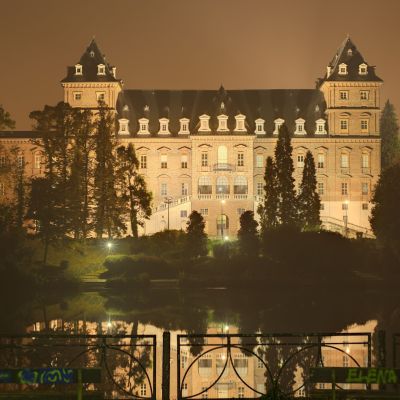
Private tours of Turin
In the Footsteps of the Madame Reali
This tour explores Turin through the powerful women of the House of Savoy, from the “Madame Reali” who once governed the duchy – Christine of France and Maria Giovanna Battista – to the queens and princesses who left their mark on the city’s royal residences and cultural institutions.
It’s a mix of grand palaces and quieter, everyday traditions: elegant apartments and gardens alongside the embroidery workshops and craft markets where women’s skilled work has been passed down for generations.
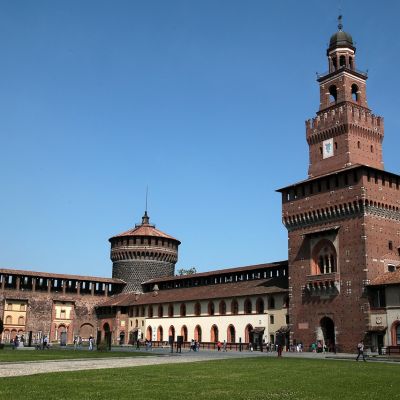
Private Guided Tours of Milan
Duchesses, Collectors, and Poets
These tours move through Milan‘s layered history via the women who shaped its art and culture, from Renaissance duchess Beatrice d’Este at the Sforza court to 20th-century collector and patron Marieda Di Stefano, whose home now holds one of the city’s most personal art collections. It also touches on the Navigli district, forever linked to poet Alda Merini, and closes with a stop at the Shoah Memorial, honoring the memory of deported women.
A visit to the historic city center, including the Duomo, rounds out the day, tying Milan’s female voices to its most iconic landmarks.
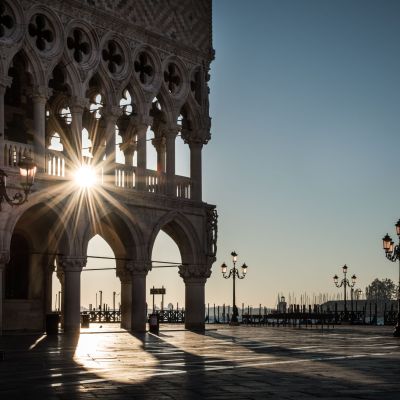
Private guided tours of Venice
Behind the Palace Walls
These tours uncover the women behind Venice’s grand facade, from the powerful dogaresses of the Palazzo Ducale, who quietly shaped the political and cultural life of the Serenissima, to salon hostess Caterina Dolfin Tron, whose gatherings at Ca’ Rezzonico drew the era’s leading intellectuals.
It also visits the Ospedaletto, home to the female musicians of Vivaldi’s Ospedale della Pietà, the Ghetto, linked to poet and scholar Sara Copio Sullam, and a charming bookshop paying tribute to Venice’s women writers past and present.
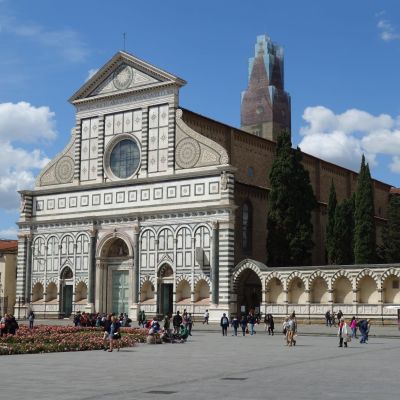
Private Guided Tours of Florence
A City Shaped by Remarkable Women
These tours look at Florence through the women often overshadowed by its famous men, from Renaissance painter Artemisia Gentileschi, one of the first women admitted to the city’s painting academy, to Eleonora di Toledo, whose political skill and patronage helped shape the Pitti Palace.
It also touches on Catherine and Maria de’ Medici, two Florentine daughters who became queens of France, and Blessed Villana, a local noblewoman turned venerated holy figure – together tracing a very different side of Florence’s Renaissance story.
The days can also include Florence’s other essential sights, such as the Accademia Gallery, the Boboli Gardens, and the climb to the top of Brunelleschi’s Dome.
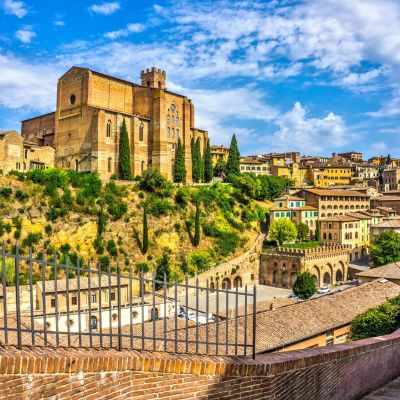
Private Guided tour of Siena
Following the Footsteps of a Patron Saint
A focused, atmospheric tour centered on Saint Catherine of Siena, one of the most influential women in Italian religious history. It traces her story from her birthplace, now a sanctuary of chapels and oratories, to the basilica housing her relics and the medieval fountain tied to her humble origins – a walk through the life of the wool-dyer’s daughter who rose to advise popes and became co-patron saint of Italy.
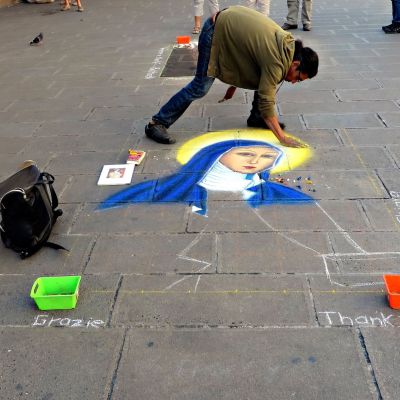
Private tour of Assisi
The Franciscan Sisters
A day trip dedicated to Clare of Assisi and the Franciscan women’s movement she founded alongside Saint Francis. The tour takes in the basilica that holds her tomb, the forest hermitage tied to early Franciscan spirituality, and the small chapel where she first took her vows – together offering a fuller picture of the women’s side of a movement usually told through its male founder.
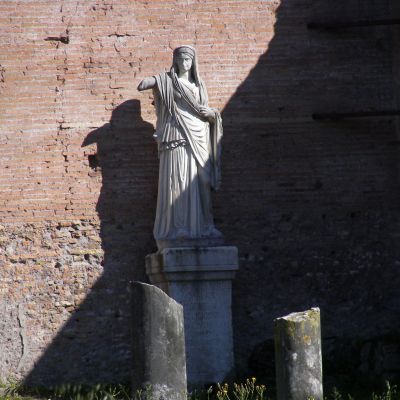
Private Tours of Rome
From the Vestals to the Modern Women
Rome’s tour spans the widest arc of the journey, moving from the sacred Vestal Virgins of the Roman Forum through early Christian martyrs and Renaissance influence to the icons of modern Italy. Highlights include the catacombs’ rare early Christian art, a Renaissance palace linked to the influential Giulia Farnese, a neighborhood built with women’s emancipation in mind, and the legacies of trailblazing
architect Zaha Hadid and cultural figures like Anna Magnani and Elsa Morante – a journey across two thousand years of Roman women’s history.
Naturally, no visit to Rome is complete without the Colosseum, and for those who wish to go further, the itinerary can also include Baroque Rome, the Vatican Museums, and St. Peter’s Basilica, rounding out the city’s essential landmarks alongside its lesser-known stories.
This is just one example of the exciting experiences you can have on a trip to Italy.
All experiences can be customised according to your preferences, e.g. you can add guided tours or change the duration of stays at different locations.
Contact us for a free quote of the “trip of your desires”!